- Introduction
- Understanding Standard Saree Measurements
- Why Saree Length Matters More Than Many Realise
- Saree Measurements and Body Proportions
- Different Saree Lengths and Their Purpose
- Regional Sarees and Their Unique Saree Measurements
- Understanding Blouse Piece Measurements
- The Importance of Petticoat In Saree Measurements
- How Different Draping Styles Influence Measurements
- How Fabric Influences the Way Measurements Feel
- Why the Same Measurements Can Feel Different
- Common Misconceptions About Saree Measurements
- Frequently Asked Questions About Saree Measurements
- Quick Saree Measurement Reference Chart
- Conclusion
Introduction
A saree may appear to be a simple length of fabric, but every beautiful drape is guided by a set of carefully balanced saree measurements. The way a saree falls, the depth of its pleats, the length of its pallu, and even the comfort of movement are all influenced by dimensions that often go unnoticed.
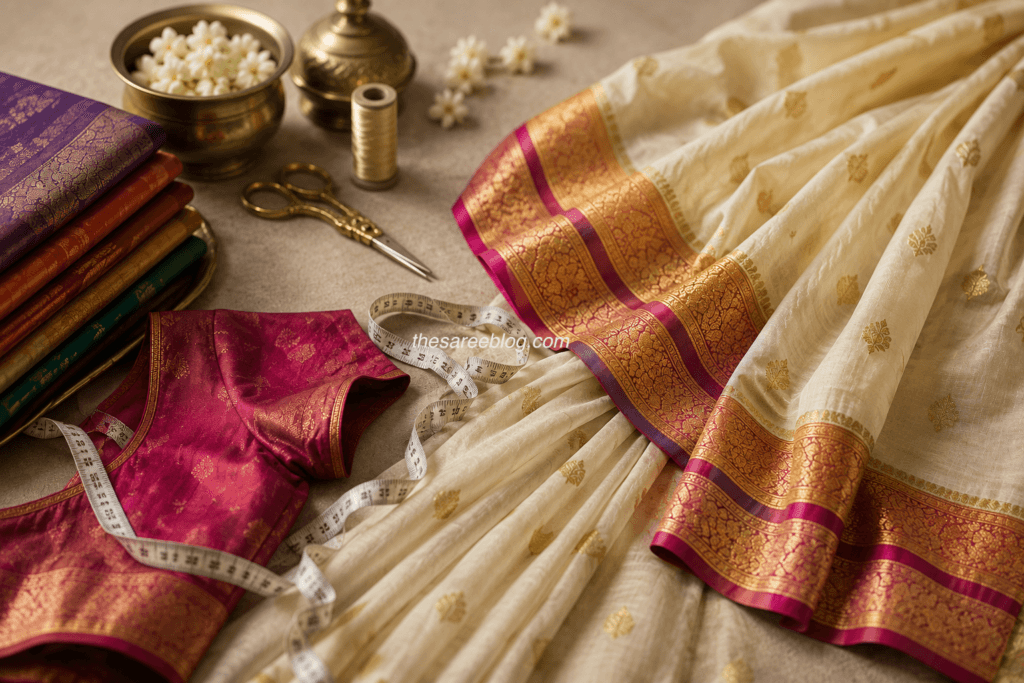
While colours, weaves, and embellishments usually receive the most attention, measurements quietly shape the overall experience of wearing a saree. A Banarasi silk and a chiffon saree may share similar dimensions on paper, yet they drape very differently. Likewise, a saree that feels perfectly proportioned for one person may require extra length or width for another.
Understanding saree measurements is not about following rigid rules. Rather, it is about appreciating how fabric, body proportions, and draping styles work together. Whether choosing a traditional handloom treasure, a festive silk saree, or an everyday cotton drape, a basic understanding of measurements can make all the difference.
Understanding Standard Saree Measurements
Across India, most sarees follow fairly consistent dimensions. These measurements have evolved over generations and are designed to accommodate the classic Nivi drape, which remains the most widely worn style today.
Although regional drapes and specialised sarees may differ, understanding the standard dimensions provides a useful foundation for exploring the diverse world of sarees.
The Standard Saree Length
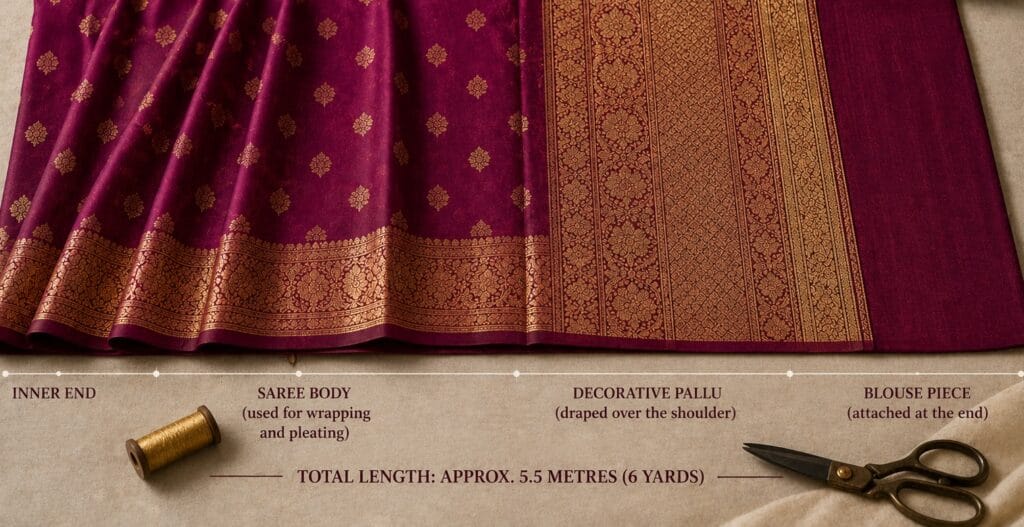
The majority of sarees measure approximately 5.5 metres in length, often referred to as six yards. This length comfortably accommodates the essential elements of a saree drape—the wrap around the waist, the front pleats, and the pallu flowing over the shoulder.
What makes this length remarkable is its versatility. It works beautifully across different fabrics, occasions, and body types, which is why it has become the accepted standard for modern sarees.
Understanding How Saree Length Is Distributed
A standard 5.5-metre saree may seem like a generous amount of fabric, but each section serves a purpose. From the pleats at the waist to the pallu cascading over the shoulder, every metre contributes to the final silhouette.
| Saree Component | Approximate Length |
|---|---|
| Waist Wrap | 1.5–2 metres |
| Front Pleats | 1–1.2 metres |
| Pallu | 1.5–2 metres |
| Tucking Allowance | Remaining fabric |
These measurements are not fixed rules. Different draping styles and personal preferences can alter the proportions slightly, but the table offers a useful reference for understanding how a saree is generally distributed.
The Standard Saree Width
While length often receives the most attention, width plays an equally important role.
Most sarees measure between 44 and 48 inches in width. This dimension allows the saree to provide adequate coverage while creating elegant pleats and a well-balanced silhouette.
A wider saree generally offers greater flexibility during draping, whereas a narrower width may affect coverage and the appearance of the pleats. Fortunately, traditional weaving standards have remained remarkably consistent, making width one of the most predictable aspects of saree measurements.
Why Saree Length Matters More Than Many Realise
A few extra inches of fabric can dramatically alter the final look of a saree.
Length influences the size of the pleats, the sweep of the pallu, and the ease with which a saree can be draped. It also affects comfort, particularly during long celebrations, weddings, and festive gatherings where the saree is worn for several hours.
For taller women, a slightly longer saree often feels more balanced. The additional fabric allows for generous pleats and a fuller pallu without compromising comfort. Conversely, petite women may find standard saree lengths perfectly adequate, creating a neat and elegant silhouette without overwhelming the frame.
Saree Measurements and Body Proportions
One of the reasons the saree has remained relevant across centuries is its adaptability. Unlike stitched garments that follow fixed sizes, a saree adjusts beautifully to different heights, body shapes, and styling preferences.
For petite women, a standard 5.5-metre saree often provides ample fabric for neat pleats and a well-balanced pallu. Taller women, on the other hand, may appreciate a little extra length, particularly when experimenting with traditional draping styles or creating deeper pleats.
Body proportions also influence how a saree is experienced. Some women prefer a sleek silhouette with fewer pleats and a longer pallu, while others enjoy a more structured appearance with fuller pleats. Measurements provide the foundation, but personal styling ultimately shapes the final look.
Saree Length Guide by Height
| Height | Recommended Saree Length |
|---|---|
| Under 5 ft | 5.5 metres |
| 5’0″–5’4″ | 5.5 metres |
| 5’5″–5’8″ | 5.5–6 metres |
| Above 5’8″ | 6 metres or longer |
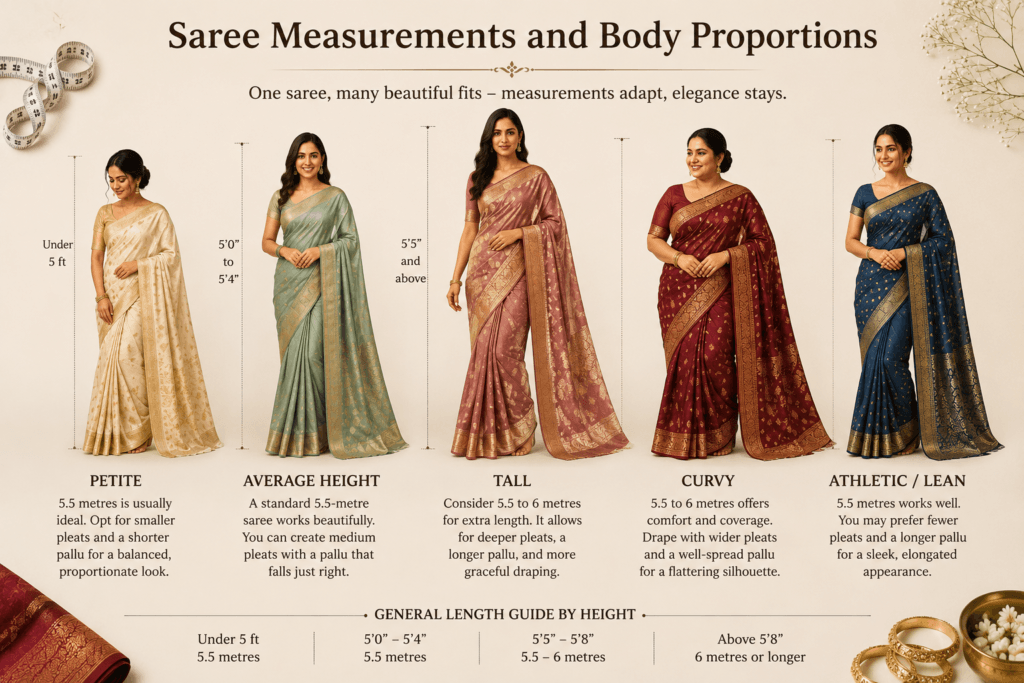
These are general guidelines rather than strict rules. Fabric type, draping style, and personal preference can all influence the ideal saree length.
Different Saree Lengths and Their Purpose
The Classic 5.5-Metre Saree
This is the saree most people encounter on a daily basis. It is suitable for office wear, festive occasions, family gatherings, and formal events. Many beloved saree varieties—including Chanderi, organza, georgette, cotton, and printed sarees—typically follow this standard length.
The 6-Metre Saree
Some sarees feature a slightly longer length, providing additional flexibility during draping. The extra fabric is especially appreciated when creating elaborate pleats or styling traditional drapes that require greater volume.
The Traditional 9-Yard Saree
Long before contemporary draping styles became common, many regions of India embraced sarees measuring eight to nine yards in length. The Nauvari of Maharashtra and the Madisar of Tamil Nadu remain among the most celebrated examples.
These sarees require significantly more fabric because the draping technique itself is fundamentally different from the standard Nivi style.
Regional Sarees and Their Unique Saree Measurements
India’s textile traditions have produced sarees that differ not only in weave and motif but also in the way they are draped and experienced.
Banarasi Sarees
Banarasi sarees generally follow the standard 5.5-metre length. However, their elaborate pallus and richly woven borders often create the impression of greater volume. The structured nature of silk also makes every pleat appear fuller and more pronounced.
Kanjivaram Sarees
Traditional Kanjivaram sarees are known for their substantial silk weave. While their measurements remain close to the standard, the fabric’s weight and grandeur influence how the saree drapes. Many women prefer a slightly longer length for bridal and ceremonial styling.
Chanderi Sarees
Lightweight and airy, Chanderi sarees demonstrate how fabric can alter perception. Even with standard measurements, they feel effortless and fluid, making them particularly comfortable during warmer months.
Nauvari Sarees
The Nauvari saree represents one of India’s most distinctive draping traditions. Measuring between eight and nine yards, it requires significantly more fabric than a conventional saree.
Understanding Blouse Piece Measurements
The blouse may occupy only a small portion of the overall ensemble, yet it plays a crucial role in defining the final look.
Most sarees include an attached blouse piece measuring between 80 centimetres and 1 metre in length. This is generally sufficient for a classic blouse with standard sleeves and traditional necklines.
However, contemporary blouse designs often require additional fabric. Full sleeves, statement backs, dramatic collars, peplum silhouettes, and heavily structured cuts may demand more material than the standard blouse piece provides.
Blouse Piece Measurement Guide
| Blouse Style | Fabric Usually Required |
|---|---|
| Basic Blouse | 0.8 metre |
| Elbow Sleeve Blouse | 0.8–1 metre |
| Full Sleeve Blouse | 1–1.2 metres |
| High Neck Blouse | Around 1 metre |
| Peplum Blouse | 1.2 metres or more |
The exact requirement depends on sleeve length, neckline design, body measurements, and tailoring preferences.
The Importance of Petticoat In Saree Measurements
A beautifully draped saree relies on more than the saree itself. Hidden beneath the folds lies one of the most important supporting elements—the petticoat.
The petticoat provides structure, helps secure the saree in place, and influences the way the fabric falls. Ideally, it should end just above the floor, allowing the saree to skim gracefully without dragging.
The waist fit is equally important. A secure yet comfortable waistband helps keep the saree tucked neatly while allowing freedom of movement throughout the day.
How Different Draping Styles Influence Measurements
One of the reasons sarees remain endlessly fascinating is the variety of draping styles found across India.
The Nivi drape comfortably fits within the standard 5.5-metre length and remains the most commonly worn style. The Bengali drape often benefits from a longer pallu and broader shoulder display, while the Gujarati seedha pallu style places the decorative end of the saree at the front, requiring a different distribution of fabric.
Traditional drapes such as Nauvari and Madisar belong to an entirely different category, requiring several additional metres of fabric to achieve their distinctive silhouettes.
How Fabric Influences the Way Measurements Feel
Interestingly, identical measurements can produce dramatically different results depending on the fabric.
Silk sarees tend to create fuller pleats because of their weight and structure. Cotton sarees maintain crisp folds and strong definition. Chiffon and georgette, by contrast, create fluid silhouettes that glide close to the body.
Organza introduces yet another dimension. Despite being lightweight, its structured nature creates volume and dramatic shape. Tissue sarees and linen sarees similarly influence how the fabric behaves, proving that measurements alone never tell the complete story.
Why the Same Measurements Can Feel Different
Consider two sarees that both measure 5.5 metres. One may be woven from lightweight chiffon, while the other is crafted from rich silk. Although identical in length, they create entirely different experiences when draped.
A chiffon saree glides into soft pleats and falls close to the body. Silk creates sculpted folds and occupies greater visual space. Organza provides structure and volume, while cotton delivers crisp definition.
The weave, texture, weight, and finish all contribute to the final silhouette, which is why experienced saree enthusiasts rarely judge a saree by dimensions alone.
Common Misconceptions About Saree Measurements
Because sarees are not sold in conventional clothing sizes, several misconceptions surround their measurements.
One common belief is that a standard saree fits everyone in exactly the same way. In reality, height, body proportions, draping style, and fabric choice all influence the final result.
Another misconception is that longer sarees are always better. While additional fabric can be helpful in certain situations, excessive length may create unnecessary bulk and make draping more challenging.
Width is also frequently overlooked. Yet it plays a crucial role in determining coverage, comfort, and the appearance of pleats.
Frequently Asked Questions About Saree Measurements
What is the standard length of a saree?
Most sarees measure approximately 5.5 metres or six yards, making them suitable for the classic Nivi drape and many contemporary styling methods.
What is the standard width of a saree?
Most sarees are between 44 and 48 inches wide, providing adequate coverage and comfortable draping.
How much fabric is included for the blouse?
A blouse piece generally measures between 80 centimetres and 1 metre, though designer sarees may vary.
Is a 5.5-metre saree suitable for taller women?
Yes. However, some taller women prefer sarees closer to 6 metres for additional draping flexibility.
Why do Nauvari sarees require extra fabric?
Traditional Nauvari draping styles consume considerably more fabric than standard drapes, which is why these sarees typically measure eight to nine yards.
Does fabric affect saree measurements?
The measurements remain the same, but different fabrics influence how the saree behaves. Silk, cotton, chiffon, organza, and linen all create distinct silhouettes.
Quick Saree Measurement Reference Chart
| Item | Standard Measurement |
|---|---|
| Saree Length | 5.5 metres (6 yards) |
| Saree Width | 44–48 inches |
| Blouse Piece | 0.8–1 metre |
| Long Saree | 6 metres |
| Nauvari Saree | 8–9 yards |
| Petticoat Length | Ankle length |
| Pallu Length | 1.5–2 metres |
While regional and designer sarees may vary, these measurements represent the dimensions most commonly encountered across India.
Conclusion
The beauty of a saree lies not only in its weave, colour, or craftsmanship but also in the proportions that bring the garment to life. Length, width, blouse fabric, and petticoat measurements may seem like technical details, yet they quietly shape every pleat, fold, and graceful movement.
Whether it is a six-yard chiffon flowing effortlessly at a summer gathering or a majestic nine-yard Nauvari worn during a traditional celebration, measurements form the foundation of the drape. By understanding these dimensions, the saree becomes easier to choose, easier to style, and ultimately more enjoyable to wear.
After all, the perfect drape begins long before the first pleat is tucked—it begins with the measurements themselves.