
By Deesha Goswami, founder of House of Falguni
A pair of fabric jhumkas weighs about eight grams. Most people notice that before anything else, and it changes how the pair can be worn: through a ten-hour wedding day, under a heavy pallu, or on an ordinary Tuesday with a cotton saree and nowhere in particular to be. The second thing is colour. Fabric jewellery is made from the same materials as the saree itself (cotton, silk, block-printed cloth, thread, mirror work), so it can pick up a border or a print in a way metal rarely can. None of this is new to the saree, either: the latkan swinging from a blouse tie and the tassel finishing a pallu are fabric ornaments too. Everything below follows from those two facts. Match the saree’s texture, take your colour from the border, and let only one thing be loud.
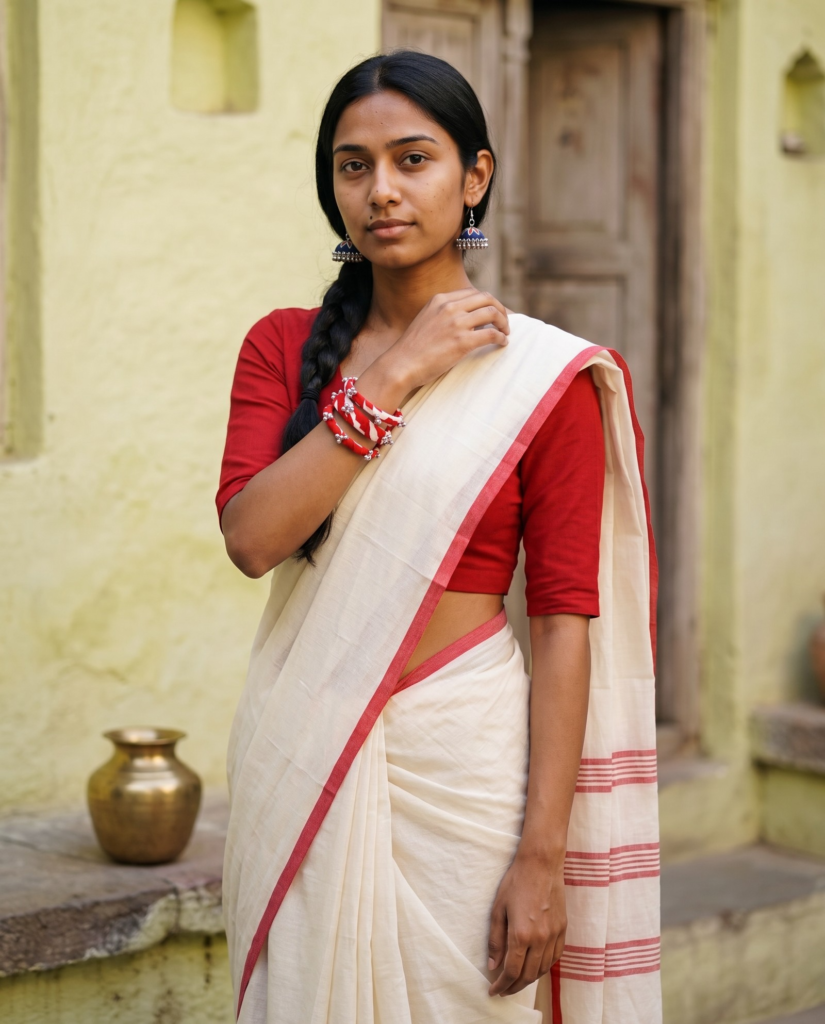
Ivory handloom cotton with a red border. The red comes back in the leheriya bangles and in the petals of the navy fabric jhumka. Pieces: Laalbagh jhumkas, Lariya Red leheriya kada set.
Start with the fabric of the saree
Handloom cotton and linen. A matte, slightly uneven weave suits jewellery with the same texture. Fabric jhumkas, printed cotton bangles and thread work sit naturally against a Mangalgiri cotton, a Bengal tant or a khadi. High-polish stones tend to look as if they were borrowed from another outfit.
Silk: Kanjeevaram, Banarasi, Paithani. These sarees already carry zari, so the jewellery’s job is depth rather than more shine. Choose fabric pieces in saturated colours (maroon, bottle green, royal blue), finished with a little kundan or a row of ghungroo, the small bells borrowed from dance anklets. They hold their own beside gold thread without trying to outshine it. A maroon chandbali beside a Kanjeevaram’s maroon border works because the two reds answer each other.
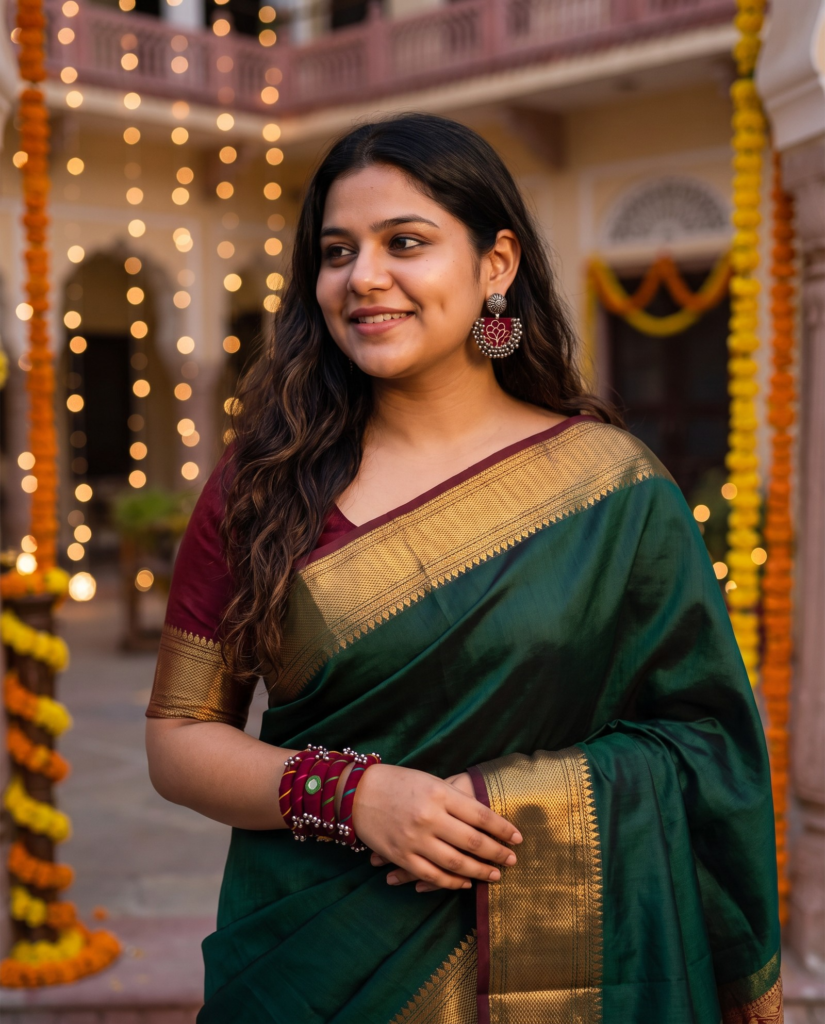
A bottle-green Kanjeevaram with a wide zari border, a maroon fabric chandbali with ghungroo, and a mirror-work kada set. Pieces: Maroon Chandbali, Rangriti Maroon mirror-work kada set.
Chiffon, georgette and organza. A light saree is always moving, and heavy jewellery drags the eye down and fights the drape. One statement earring or a single neckpiece is enough. Light fabric pieces earn their place here: they move with the saree instead of against it.
Take your colour from the border, not the body
Most sarees have two colours that matter: the body and the border, or the pallu. Jewellery that matches the body tends to flatten the look. Picking up the border colour frames the face and ties the drape together.
- Ivory with a red border: red or maroon earrings, and a red leheriya bangle stack on one wrist.
- Black: bright colour always works, but plain black fabric with silver-toned ghungroo looks deliberate and modern.
- Pastels (mint, blush, powder blue): go one shade deeper in the same colour. Save sharp contrast for a saree whose border already introduces it.
- Bandhani or Patola in many colours: pick the saree’s second colour, not its first. The jewellery then reads as a choice rather than a match.
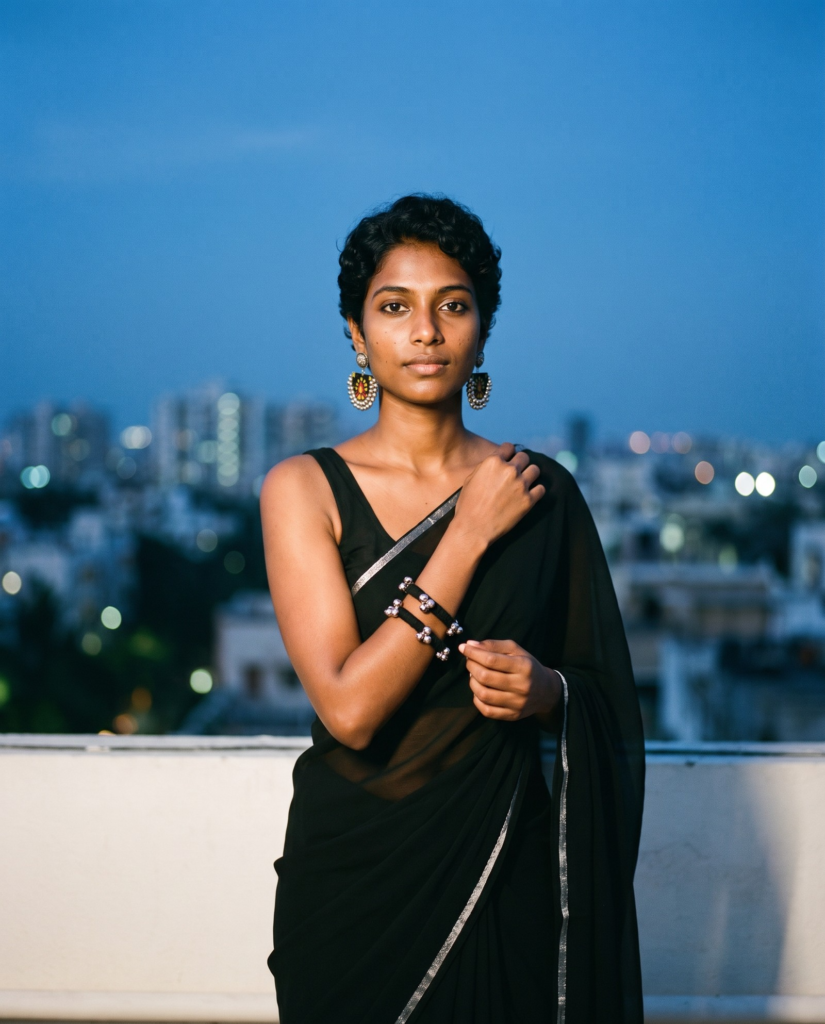
Black georgette, plain black fabric bangles with silver-toned ghungroo, and a black chandbali. Pieces: Black Chandbali, Kaali Jingles bangles.
Prints: one hero at a time
Ajrakh, Bagru, Kalamkari and Sanganeri florals already have plenty to say. Pair them with solid jewellery: a plain fabric bangle, a single-colour jhumka, or mirror work in one shade. Print on print can work, but only inside one family: an Ajrakh saree with an Ajrakh-printed neckpiece in the same indigo and madder red, for instance.
The reverse is just as useful. A plain saree, a solid silk or an unpatterned handloom, is the best place for printed fabric jewellery. A block-printed neckpiece or a leheriya bangle becomes the detail people ask you about. If you are not sure whether a print is hand block or machine, the small irregularities at the repeat are the first place to look.
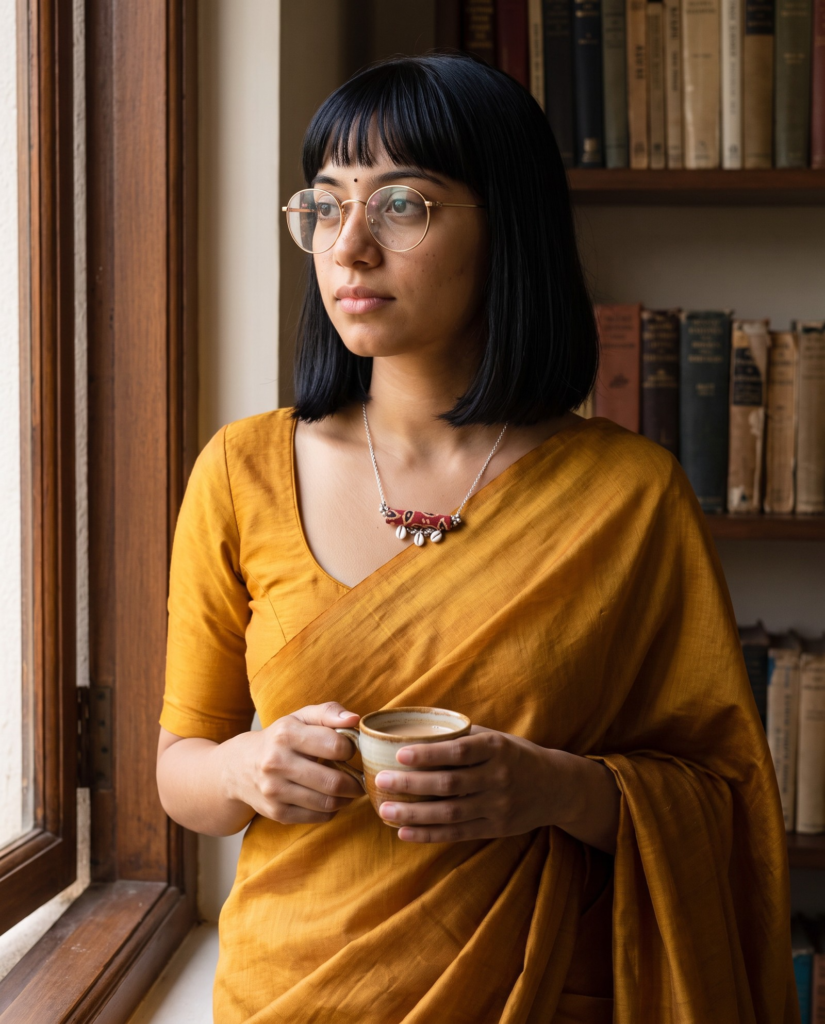
Plain mustard silk and a deep U neckline leave room for one printed piece: a paisley fabric bar with cowrie shells. Pieces: Maroon Meadow paisley fabric bar neckpiece.
Let the blouse decide how much room you have
- Boat neck or high neck: skip the necklace and let longer earrings, a chandbali or a jhumka, do the work.
- Deep U or sweetheart neck: a short neckpiece fills the space. A printed fabric bar on a fine chain sits well here.
- Collared or shirt-style blouse: studs or small drops. Anything larger crowds the collar.
- Sleeveless: this is the moment for bangles. A kada, the broad bangle, with a stack of thinner bangles on one wrist balances a bare arm.
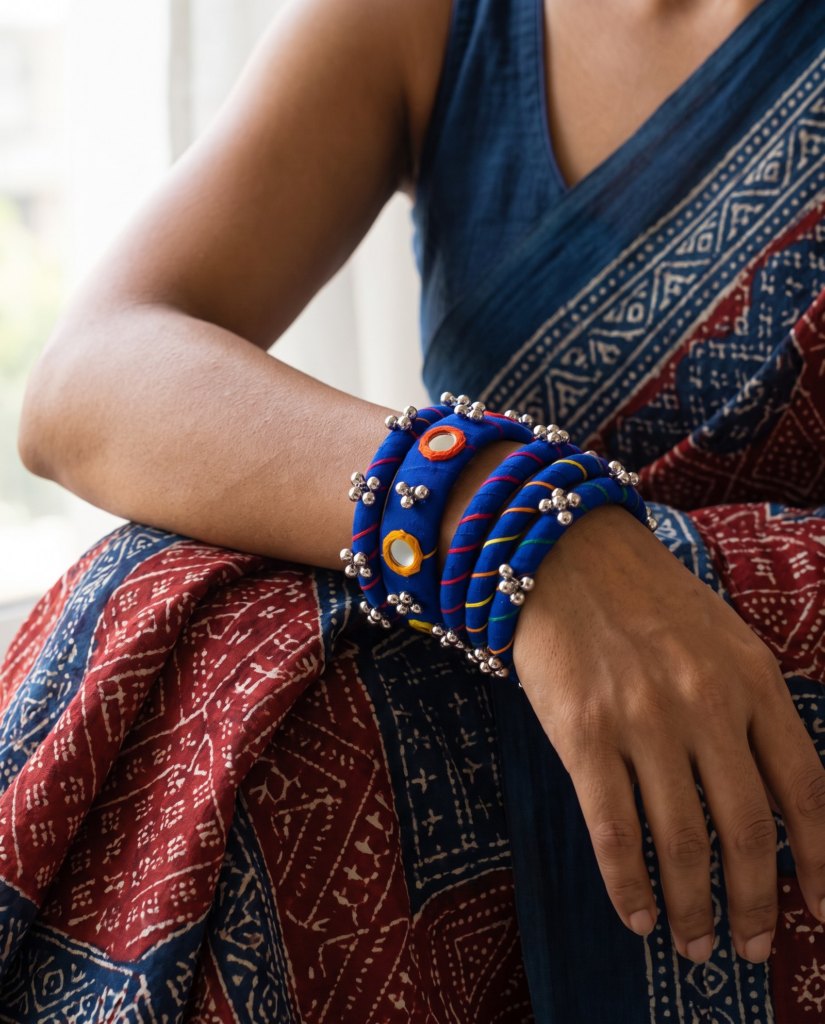
Mirror work in one colour beside an Ajrakh pallu: the print stays the hero. Pieces: Rangriti Blue mirror-work kada set.
One practical note. Tassels, bells and bead fringes can catch on zari or an embroidered pallu. If the pallu is heavy, wear your statement earring on the other side, or choose a stud for the day.
Your hair changes the earring
A low bun or a long braid shows everything at the ear, so this is when a jhumka or a chandbali is seen at its best. Open hair, especially if it is long and thick, swallows studs and small drops completely. Either go longer, or move the interest to the wrist.
A gajra changes things again. The flowers already bring white and fragrance to the back of the head, so keep the earrings in the saree’s colour rather than adding more white beside them.
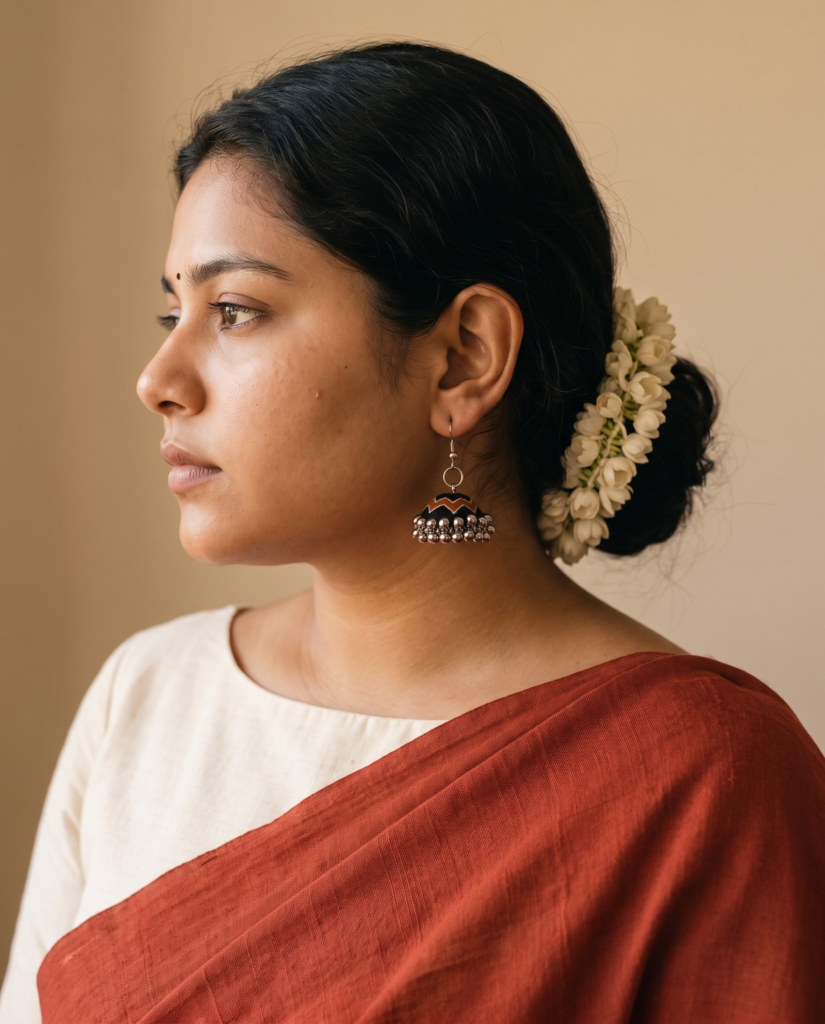
A low bun with a gajra. The jhumka picks up the saree’s rust instead of adding more white. Pieces: Neel Katha jhumkas.
Dress it for the occasion
Office and everyday. A cotton or linen saree, small fabric studs or a light jhumka, and one bangle. Leave the ghungroo for the evening. The bells make a soft sound with every movement, which is lovely at a sangeet and less so in a quiet meeting room.
Mehendi and haldi. Daytime functions with colour everywhere are where fabric jewellery is most at home: bright jhumkas, mirror-work bangles, ghungroo that rings when you dance. One caution: haldi stains cotton. Wear your fabric pieces to the mehendi and keep them away from the haldi bowl itself.
Wedding evenings and receptions. Silk sarees and richer colours. A chandbali with ghungroo, or a fabric earring set with kundan, stands up next to zari. A pair of fabric chandbalis weighs around twelve grams, so they can stay on well past the pheras.
Pujas and family dinners. A kada set with mirror work and a matching pair of small studs: festive, but quiet enough for a living room full of relatives.
Three pieces that cover most of a wardrobe
If you are starting from nothing, you need fewer pieces than you might think. One pair of jhumkas in a deep colour that half your sarees share, usually indigo, maroon or black. One pair of small studs for work and travel. One kada set with mirror work for functions.
Add printed pieces after that, and choose them by looking at your plain sarees first. The print you buy should be the one those sarees are missing, not another version of a print you already own.
Caring for it the way you care for the saree
Fabric jewellery asks for much the same care as a good saree. Put it on after perfume and hairspray, never before. Keep it dry: cotton and silk fibres swell when they are wet, and water can loosen both the dye and the shape. Store each piece flat in a box or a cloth pouch, out of direct sun, and away from metal jewellery, which snags thread. Wipe mirror work with a soft, dry cloth.
A quick check before you leave
- Does the jewellery match the saree’s texture, matte with matte and rich with rich?
- Have you taken a colour from the border rather than the body?
- Is only one thing loud: the print, the earrings or the bangles?
- Does the neckline leave room for what you are wearing?
- Will the tassels clear the pallu?
Fabric jewellery is not a stand-in for gold. It does a different job. It is light, it can match what metal cannot, and it carries the same craft as the saree beside it. Wear it as part of the drape, not as an afterthought.
About the contributor
Deesha Goswami is a textile engineer and the founder of House of Falguni, an Ahmedabad label that makes jewellery and accessories from fabric: block-printed cotton, mirror work, leheriya and ghungroo, finished by hand in small batches. The label is named after her mother, Falguni, who taught her to notice small, deliberate things.
Image credit
Images: House of Falguni. All six images are House of Falguni’s own, made for this article; The Saree Blog may publish them with the article and in its social posts about it.

